Foodie

Foodie

Fridge manager that gives computer vision the one thing it's been missing: ground truth.

Foodie is a 2-step verification for food identification. It pairs digital purchase data with computer vision.

Foodie is a 2-step verification for food identification. It pairs digital purchase data with computer vision.

This project was built to solve the smart-fridge industry's biggest gap: a feature nobody uses.

Foodie is a 2-step verification for food identification. It pairs digital purchase data with computer vision.

This project was built to solve the smart-fridge industry's biggest gap: a feature nobody uses.

This project was built to solve the smart-fridge industry's biggest gap:

a feature nobody uses.

Year

2026
3 months

Discipline

Business modeling
User interface
Product strategy
Market research

Smart fridges in the U.S.

Smart fridges in the U.S.

Smart fridges in the U.S.

The $1.26 billion smart refrigerator market was hyped up with features like food tracking and recipe suggestions, but people barely use them. This gap in the market was the starting point for Foodie.

The $1.26 billion smart refrigerator market arrived with big promises that people were hyped about: track your food, suggest recipes, catch expiration dates before you do.


However, people barely use them.

From a model explaining people's intent to use smart fridges in the U.S.

(NOVA IMS dissertation, 2023)

From a model explaining people's intent to use smart fridges in the U.S.

(NOVA IMS dissertation, 2023)

Expected

70%

70%

of behavioral intention

but only

24%

24%

actual use behavior

Why do people not use smart features?

Why do people not use smart features?

Why do people not use smart features?

At CES 2026, Samsung's flagship AI fridge won Worst in Show because the AI vision camera couldn't identify basic food ingredients.

Forcing users back to manual entry, the exact task the feature was supposed to eliminate, naturally leads to decreased usage.

At CES 2026, Samsung's flagship AI fridge won Worst in Show because the AI vision camera couldn't identify basic food ingredients.


Forcing users back to manual entry, the exact task the feature was supposed to eliminate, naturally leads to decreased usage.

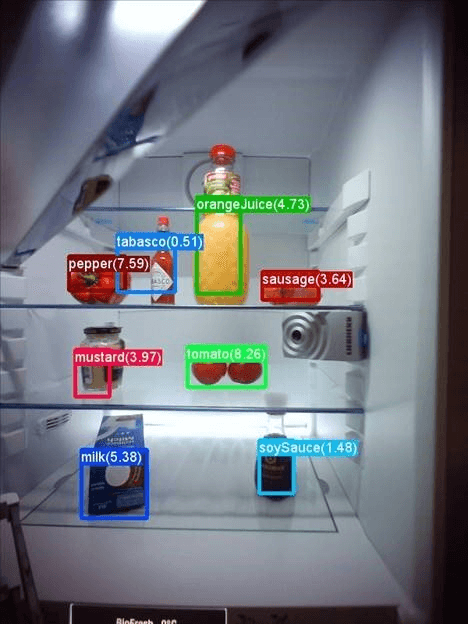
Why can't the camera tell the difference?

Computer vision in the fridge fails because it has no ground truth to check itself against.

Even if the model has been trained with thousands of images, every time a food item enters the fridge, it has to compare and guess with those thousands of images.

Computer vision in the fridge fails because it has no ground truth to check itself against.


Even if the model has been trained with thousands of images, every time a food item enters the fridge, it has to compare and guess with those thousands of images.

Visual input isn't enough

To better the accuracy, this model needed more data acquisition than just images: digital purchase data.

I chose email receipts as the data acquisition method for two main reasons:

  • Barcode scanning and manual logging depend on human input, which is unreliable since most people simply don't do it.

  • Grocery delivery and order APIs offer cleaner data, but only cover online shoppers, when the majority still shop in-store.

What does receipt data improve?

Receipt data narrows the guesswork downstream, improving two key steps in the processing:

Feature-based classification

Instead of the model choosing from thousands of possible food classes, it only needs to pick between items that were bought recently.

Post-processing

If the classifier returns a low-confidence or ambiguous guess, receipt data can be cross-checked against what's expected to be in the fridge and nudged toward the more likely match.

Foodie: a license model for Samsung SmartThings, training Vision AI with digital purchase data.

Vision AI scans the fridge and guesses each item based on data set

Vision AI scans the fridge and guesses each item based on data set

Foodie cross-references it against parsed receipt data

Foodie cross-references it against parsed receipt data

Receipt data resolves the match

and the model gets smarter with every correction

Receipt data resolves the match

and the model gets smarter with every correction

Receipt data resolves the match

and the model gets smarter with every correction

The opportunity

There is a huge installed base of smart fridge hardware that is collecting dust in homes.

US Smart Refrigerator market

Scalability

Scalability and growth reinforcing each other rather than competing for resources.

I pitched Foodie in front of founders and investors in NYC!

Foodie placed 3rd and I had the chance to connect and get valuable feedback. :D

What did you learn?

What did you learn?

What did you learn?

Always pivot

Foodie's first version was a B2C product bundled with its own camera hardware. Midway through building the prototype, I realized the business model wouldn't hold up. Customer acquisition costs alone would sink it. Pivoting multiple times taught me that this will always bring a greater outcome than continuing a product you already know will fail.

©2026 Made by ehyun! All rights reserved

©2026 Made by ehyun! All rights reserved

EhyunLLM